Insights

What Happens When Reinsurance Stops Being Cyclical

June 19, 2026
 - 
3
 min read

For most of the last three years, the reinsurance market has been hard. Premium rates climbed double-digits, balance sheets were rebuilt, and institutional capital flowed in to ride the spread. That pattern is older than the asset class itself: investors arrive when the cycle turns hard, hold while it pays, and rotate out once pricing softens. Underwriters know it well enough to plan around it.

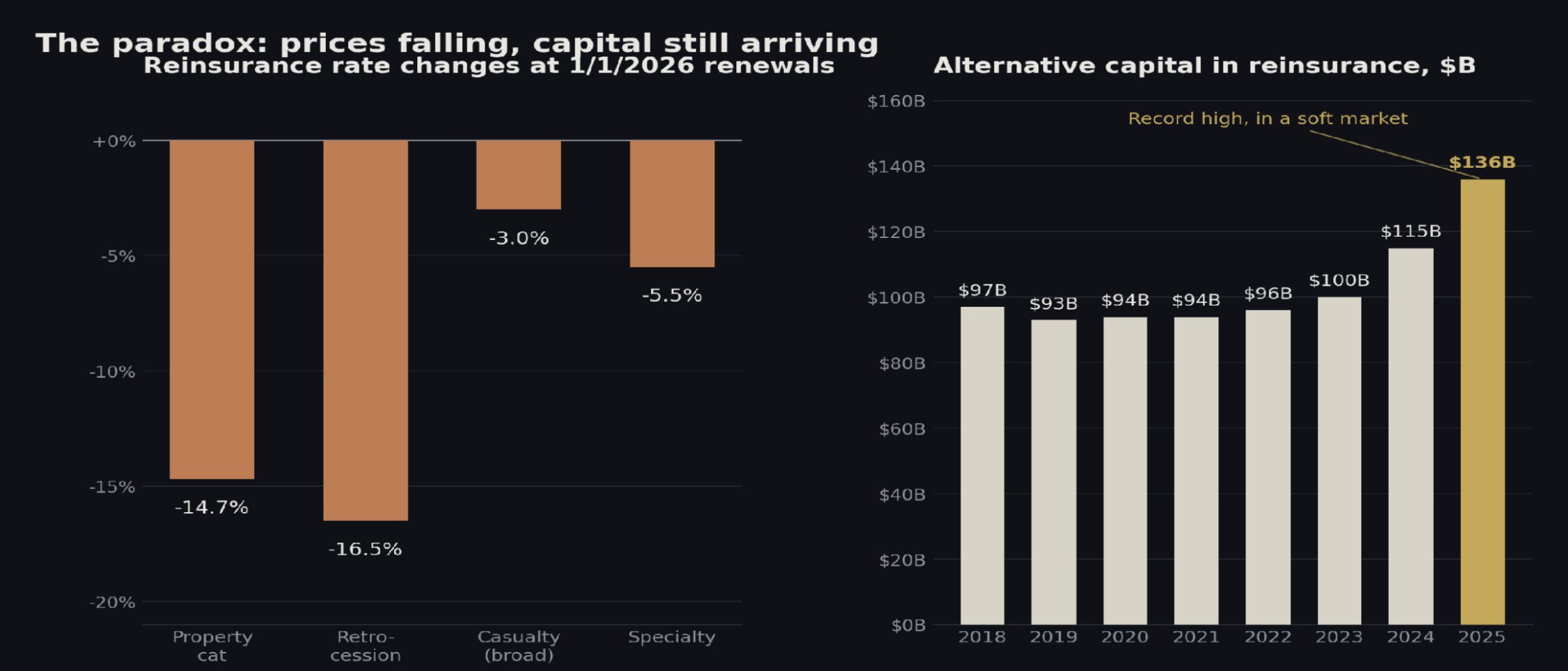
The 2026 renewals turned soft. Property catastrophe rates fell 14.7% in January, retrocession 16.5%, and brokers across the market called the cleanest break from the hard market in three years. Every signal lined up with the pattern. According to the textbook, capital should have begun to leave.

A Soft Market With Record Capital

Global reinsurer capital ended 2025 at $785 billion, an all-time high. Inside that base, alternative capital, the share supplied by capital markets rather than reinsurers' own balance sheets, hit $136 billion at year-end, up more than 18% from 2024.

Alternative capital just posted its largest annual increase on record, in the same year reinsurance pricing began to fall.
Image
Sources: Howden Re, Re-balancing 1.1.26 renewal report (rates). Aon, Reinsurance Market Dynamics April 2026 Renewal Report (alternative capital).

ILS index returns moderated from roughly 14% in 2023 to 11% in 2025, and inflows accelerated. Catastrophe bond outstanding crossed $60 billion at year-end 2025, with Q1 2026 issuance tracking the second-highest first quarter on record.

This is not how cyclical capital behaves.

What the Allocators Are Actually Buying

Gallagher Re surveyed more than 60 institutional ILS investors in early 2026. 94% had direct responsibility for allocation decisions. 72% managed over $1 billion; 16% managed over $100 billion. The headline finding: investor appetite was both increasing and becoming more sophisticated even as cycle returns compressed.

The capital coming in is paying for diversification, and underwriting risk is one of the only sources of it left at institutional scale.

Aon's read on its own data was the same. Third-party capital, in its words, is supported by consistent investor appetite for non-correlating risk.

Equity beta lives in the equity sleeve. Credit risk lives in the credit sleeve. Reinsurance is one of the rare exposures that sits in neither.

When markets move together, that distinction becomes valuable.

A softer market changes the number. It does not change the structure.

The Asset Class Outgrew its Access

That structure has been institutional gospel for a decade. What the data also shows is what the structure has not done in that decade: open up.
Image
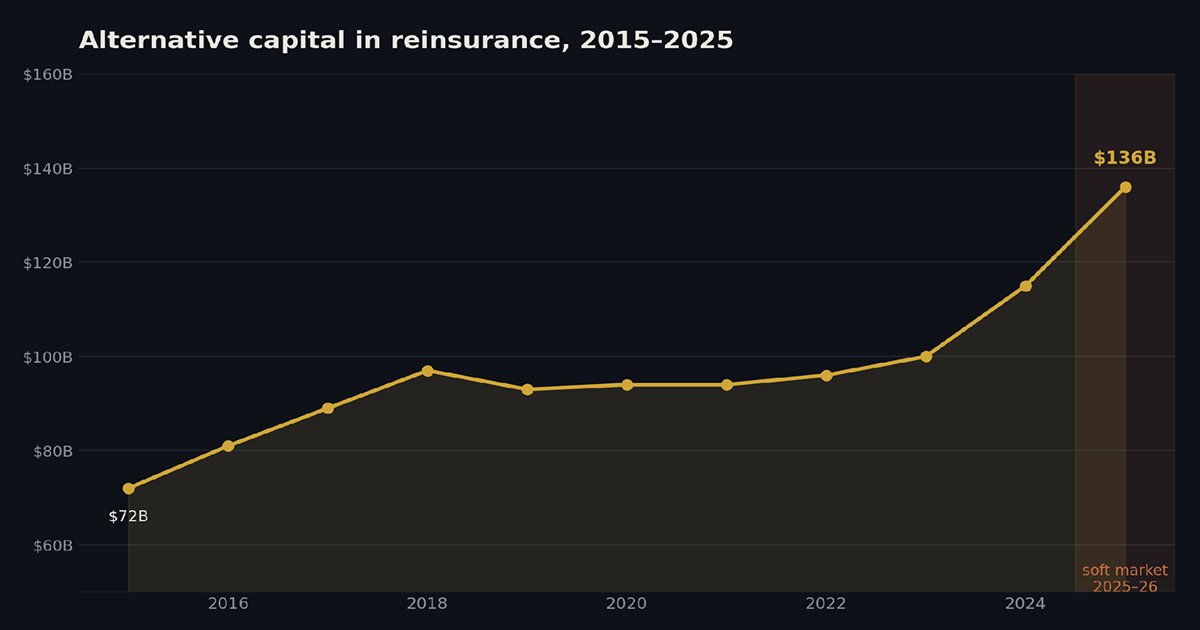
Source: Aon Reinsurance Solutions, Reinsurance Market Dynamics renewal reports. +89% growth 2015-2025; +18% YoY in 2025 alone.

Access still runs through $10 million minimums on most ILS funds, quarterly or annual liquidity windows, intermediated reporting from offshore administrators, and a documentation cycle that begins with a private placement memorandum. Pension funds and sovereigns can absorb that friction. Almost no one else can.

A decade of record inflows into one of the most diversifying assets in institutional finance, still gated by the operational mechanics of the 1990s.

The question is no longer whether investors want reinsurance exposure. The question is whether the access layer can evolve quickly enough to meet the next generation of allocators.

Onchain capital is the natural next allocator. Stablecoin balances, DAO treasuries, crypto-native funds, and family offices with digital custody hold meaningful capital that cannot reach traditional ILS structures at all. The demand exists at the same intensity. The rail does not.

Built for the Demand That Was Already There

OnRe is a Bermuda-licensed collateralized reinsurer. ONyc brings that exposure onchain.

No $10 million minimums. No quarterly liquidity windows. NAV updates daily onchain, redemptions run through a transparent queue, and the position composes across Solana DeFi as active collateral.

Unlike traditional ILS structures, ONyc can be deployed across lending markets, liquidity venues, and structured products while retaining exposure to the same underlying premium stream.

The underlying economics are the same ones that have attracted institutional capital to reinsurance for years. The infrastructure around them is new.

The Cycle Does Not Change the Thesis

Reinsurance pricing will keep moving. Some years are hard, some are soft, and 2026 is soft.

The pattern that matters is the one institutional allocators have been pricing for a decade: capital comes in because the returns do not correlate with anything else the portfolio holds, and that pattern persists across cycles.

The 2026 numbers extended that pattern past the most natural test it could face. Rates fell at the steepest pace since 2014, every signal aligned with the textbook rotation, and capital still moved the other way.

What the textbook missed was that the textbook itself was written about a different kind of allocator.

The investors writing checks today are not the ones who left when prices dropped in 2014. They are pension funds, sovereigns, and asset managers who treat reinsurance as portfolio infrastructure rather than opportunistic exposure. They do not rotate.

What rotates next is the rail underneath. Traditional ILS was built when the only institutional pools that mattered sat in fund administrators and trust accounts. The pools that will define the next decade – onchain treasuries, crypto-native allocators, and regulated digital asset allocators – were not addressable by the structure that scaled the asset class. The structure is the thing that has to change. The data suggests it already is.

Share this article
Up next
No items found.

Bridging reinsurance and crypto to create real, scalable yield