Property catastrophe reinsurance and casualty reinsurance are both marketed as uncorrelated investments. Their diversification comes from different sources because duration determines what remains exposed after a contract is written.
Casualty sidecars now account for roughly 10% of total sidecar capacity, following rapid growth from a historically limited presence in the alternative-capital market. [1] Ascot Group and Antares Capital put $500 million into Wayfare Re in July 2025. Enstar followed with Scaur Hill Re. QBE Re placed more than $550 million through George Street Re. Everest launched Annapurna Re in June 2026 expecting to deploy $600 million.
Each is marketed on returns uncorrelated with financial markets. So is property catastrophe reinsurance.
The label is accurate but incomplete, because two structures can both be uncorrelated to equities while remaining exposed to entirely different risks. That difference begins with one question: how long does the risk stay open?
Tail length is the interval between exposure and closure
Tail length is the period between when a policy provides coverage and when its final claim is settled.
Property catastrophe runs short. A windstorm makes landfall or it does not. Damage is physical, reported relatively quickly, adjusted against a defined limit, and ultimately settled. S&P Global Ratings describes property sidecars as settling claims quickly, with clear visibility on loss development and exit timelines, and lifespans of one to three years. [1]
Casualty runs long. A liability claim can surface years after the policy period, and what it finally costs can depend on a medical outcome and the course of litigation, often against precedent that did not exist at pricing. S&P notes these claims can take years to fully emerge. [1]
A short-tail result is largely observed. A long-tail result is estimated, then re-estimated, until the claims finally close.
.png)
A long tail remains exposed to variables that can move after pricing
Every additional year a claim remains open creates more time for conditions to diverge from the assumptions made at underwriting.
Start with claims inflation. Pricing terms are established at binding. Ultimate claims costs develop over time. Swiss Re's latest sigma names rising claims inflation among the forces shaping this cycle, warning that inflationary pressure feeds through to repair, replacement, and liability costs. [2] Over twelve months the gap is narrow. On a claim settling in 2032, it is the margin.
Then reserve development. A long-tail reserve is an estimate revised every quarter, and adverse development books a loss against a contract underwritten years earlier, whose premium is long since deployed. The risk did not move, the estimate did.
The third variable is built into the structure itself. Casualty liabilities take years to pay, so the capital behind them does not need property-level liquidity, and S&P observes that casualty sidecars may run lower liquidity and hold more illiquid or higher-yielding assets. The agency puts additional weight on investment and liquidity risk for that exact reason: adverse investment performance can reduce the collateral available to pay claims. [1]
That duration can also contribute to the return. Capital that stays deployed for years earns investment income on the float, which helps explain why S&P notes that casualty sidecars may hold more illiquid or higher-yielding assets.
Duration does more than extend the risk period. It can introduce additional exposure through the asset side of the balance sheet, even when the underlying insurance risk itself has not changed.
A short tail closes before any of that arrives
Twelve months leaves those variables far less time to materially reshape the outcome.
Premium generally arrives upfront, and the trigger is a physical event against a defined limit. Loss information emerges relatively quickly, giving inflation and reserve assumptions less time to materially reshape the result. Reserve development can continue after the event, but over a much shorter horizon than in casualty. Capital that may be needed to pay claims quickly remains in more liquid collateral, limiting the scope for additional investment risk.
Variance comes down to whether the event happened. Hurricane occurrence has no causal link to credit cycles or policy rates. Pricing can move with capital supply, but the event itself cannot.
Both structures are intended to provide returns driven primarily by insurance risk rather than traditional financial markets. Shorter-duration contracts leave less time for macroeconomic developments to influence ultimate claims costs.
Soft pricing reaches new business at renewal
Duration also determines how pricing cycles affect a portfolio. The July 2026 renewals provide a useful example.
Gallagher Re's 1st View put non-marine retrocession catastrophe rates down 10% to 20% at July 1 for loss-free accounts, risk loss-free down 5% to 10%, continuing the pattern set at the January and April renewals. [3] Swiss Re projects global non-life real premium growth slowing to 0.6% in 2026 against a 3.6% long-term trend. [2]
A short-tail contract written before the reduction continues under its existing terms, with softer pricing affecting the business written next. In a long-tail portfolio, liabilities from business written during a softer market can remain open for years, alongside the inflation and reserve uncertainty that develops over that period.
Terms have held while price moved. Franklin Templeton lifted its catastrophe bond conviction to strongly overweight for the third quarter, with spreads moderating from the 2022 and 2023 dislocation levels, and notes that attachment points and core terms have not weakened meaningfully in over three years. [4] Softening with structure intact is a different regime from softening with terms giving way.
Shorter duration reduces reliance on long-horizon estimates
A book that largely resolves inside its own risk period can be marked daily with less reliance on long-horizon estimates, because premium accrual, reserve movement, claims, and collateral yield all fall within the reporting window. A long-tail book can be marked just as frequently, but a larger share of that mark necessarily reflects estimates of claims that remain open.
OnRe was designed around this principle. Its portfolio is built on short-duration contracts, supporting a daily onchain NAV as more of the underlying activity resolves within the reporting window.
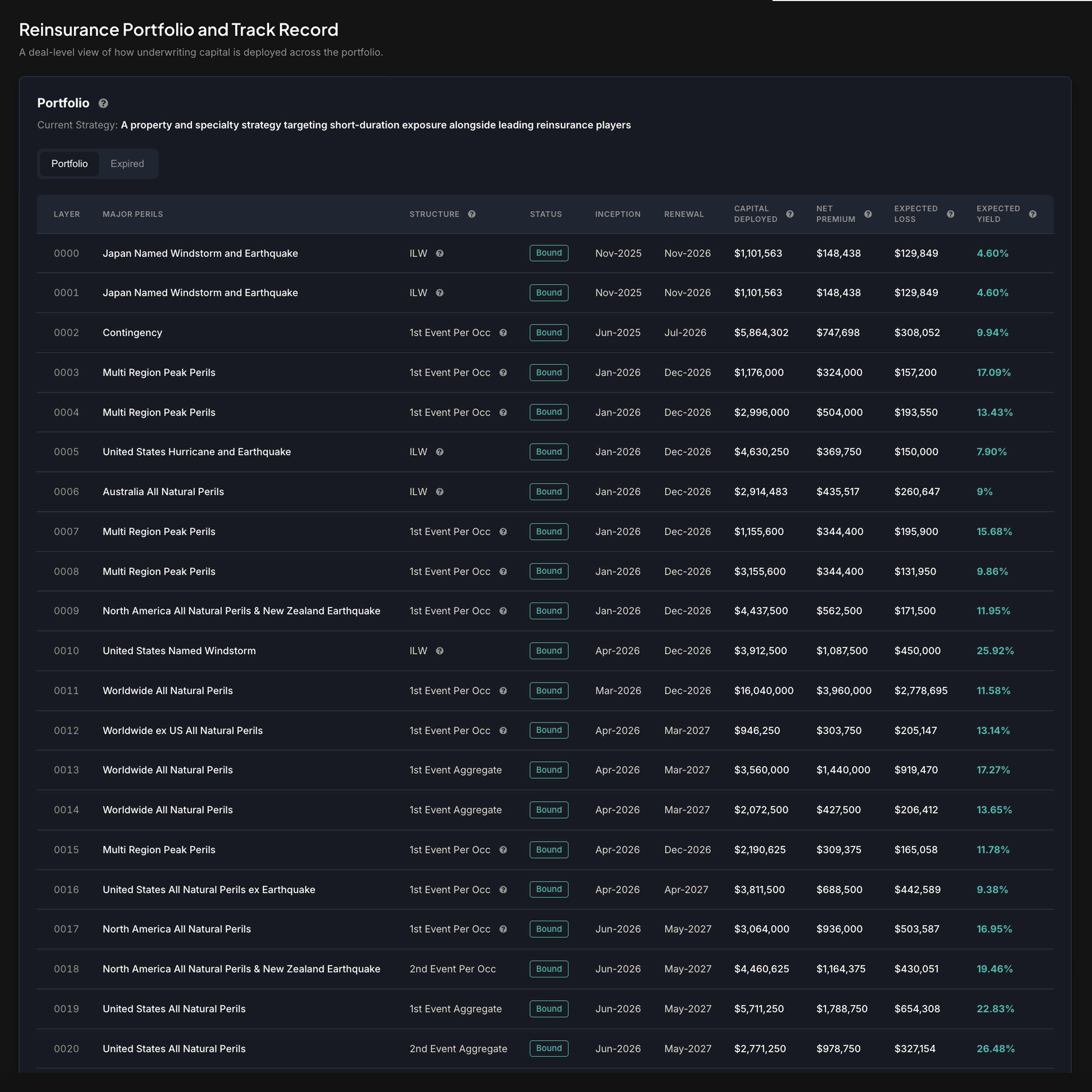
What short tail costs
A short-tail book resolves fast in both directions. A severe event affects the portfolio over a compressed period, while a long-tail result may emerge through reserve estimates and subsequent development over several years. That concentration of recognition is one cost of shorter duration.
Property catastrophe carries internal correlation by region and by peril; limits and geographic spread manage the concentration without removing it. Adverse development beyond existing reserve estimates reduces NAV as expected losses are revised upward, and a short-tail mark can reflect that deterioration relatively quickly. And the same mechanism that keeps a soft market out of the open position puts it into the next one immediately, so a book that reprices annually feels every turn of the cycle at full strength.
Long-tail casualty and short-tail property catastrophe both play important roles in insurance markets, but they diversify different sources of uncertainty. Duration determines how long a contract remains exposed to forces beyond the original underwriting, shaping the risks that remain after a policy is written. That helps explain why two investments can share the same "uncorrelated" label while behaving differently over time.
.png)
.png)
.png)