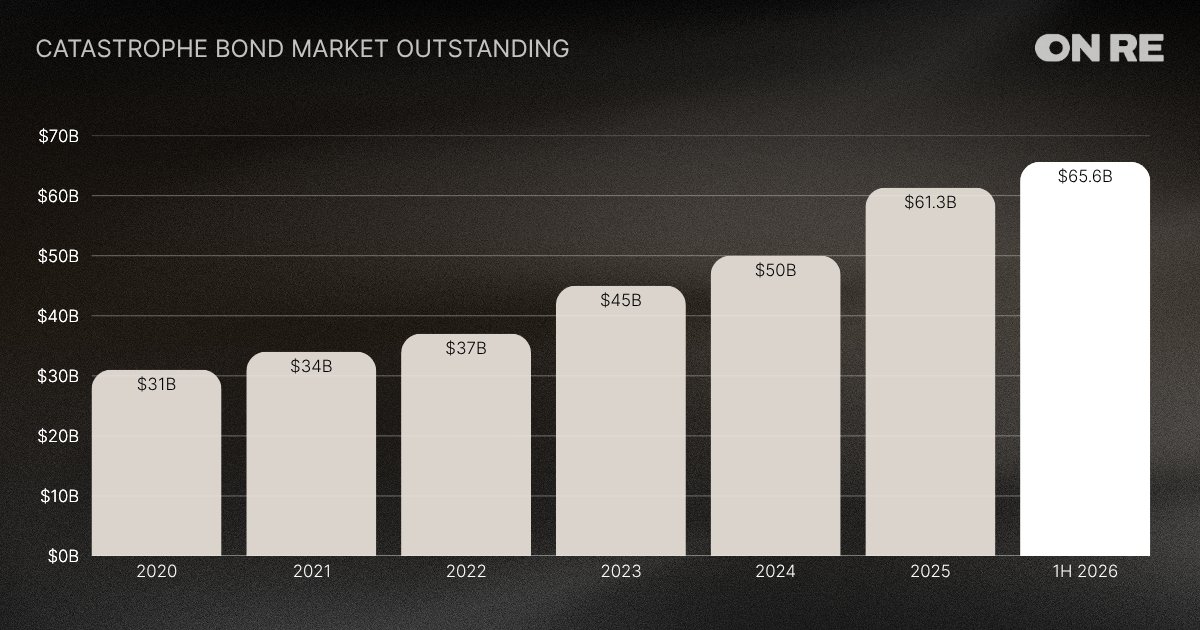
The catastrophe bond market closed June at an all-time high of $65.6B outstanding, surpassing the $61.3B record set at the end of last year. More than $11.3B of new risk capital came to market in the second quarter alone, across a record number of transactions. [1] An instrument once treated as a niche corner of insurance now sits at the center of how the industry moves risk to capital.
What the catastrophe bond proved
A cat bond gives capital markets direct exposure to insurance risk. An investor takes on a defined slice of catastrophe exposure, earns a spread for holding it, and collects a return determined by whether a hurricane or earthquake occurs. The return depends on insured events rather than where equity markets trade. Holding an insurer's stock leaves you exposed to macro cycles, while holding the securitized risk gives you the insurance exposure itself.
The market spent three decades proving demand for that exposure is real. Issuance grew from an experimental structure in the mid-1990s to a record $25.6B in 2025, up 45% year over year, and the outstanding market has roughly doubled since 2020. [2] Sponsors now include insurers, reinsurers, corporates, and sovereign entities, reflecting how what began as a specialist tool has become core infrastructure for moving catastrophe risk to capital.
The ceiling it didn't break
The catastrophe bond remains an institutional instrument. Deals clear under 144A rules, settle bilaterally, and carry the minimums that come with that structure. In private ILS, capital enters through collateralized structures with lockups, gates, and slow-pay mechanisms that reflect real settlement timelines, and allocators are advised not to plan on full redemption in under a year. [3]
A deployment still starts at six or seven figures. Securitization widened who could hold catastrophe risk, from a handful of reinsurers to a broad institutional base, but the size of the ticket stayed largely the same. Investors still buy the exposure, hold it to maturity, and wait for settlement before that capital becomes available again.
Tokenization is the next step on the same curve
Cat bonds expanded access to insurance risk through securitization. Tokenization builds on that foundation by making the exposure easier to access, easier to settle, and natively programmable.
Exposure that once required a seven-figure commitment to an ILS fund can now be held in ten-dollar increments. Settlement that ran bilaterally becomes programmatic, while a position that once remained locked until maturity becomes composable across DeFi and usable as collateral while it continues earning.
The underlying economics carry over intact. Premium income is still earned over defined risk periods, the exposure is still to the same catastrophe risk, and pricing still rests on the actuarial discipline that has governed this market for decades. What changes is who can hold that exposure and how they can use it once they do.
Reinsurance is among the first real-world cash flows making that transition.
What the risk can do onchain
ONyc brings that same reinsurance exposure onchain as an asset that continues earning while remaining usable across DeFi.
Supplied as collateral in a lending market, it earns underwriting yield alongside lending yield without leaving the underlying exposure. Because the premium-backed base yield can sit several points above stablecoin borrowing costs, the cash flow itself can support leverage without relying on token emissions. Through fixed-rate markets, the same stream can also be separated into fixed and leveraged positions for different investors.
Traditional ILS positions generally cannot be posted as collateral while continuing to earn, leveraged in open markets, or divided into fixed and floating exposures by the end investor. Putting reinsurance onchain expands what the asset can do while preserving the same underlying risk.
Beyond access
For thirty years, expanding access to insurance risk meant making it easier for institutional capital to invest. Securitization brought new investors into the market, but the position itself remained largely passive once purchased.
Onchain infrastructure adds another layer by making that same exposure usable across DeFi. The same dollar of reinsurance exposure can earn underwriting income while serving as collateral in lending markets or supporting fixed-rate products.
As more real-world assets move onchain, composability will matter alongside yield, liquidity, and credit quality. Reinsurance enters that environment with a cash flow that has long been valued for its diversification and durability. Cat bonds established institutional demand for direct catastrophe risk. ONyc brings that same exposure onchain, where it becomes broadly accessible and natively composable.
_____
.png)
.png)