Insights

Reinsurance Runs on Two Clocks

August 18, 2026
 - 
4
 min read

Most markets discover price continuously. Reinsurance discovers it on dates.

January 1 is the largest renewal date of the year, when roughly half of global reinsurance business renews. Other major renewal windows follow throughout the year, concentrating the negotiation and repricing of reinsurance risk around April 1, June 1, and July 1. At each renewal, insurers and reinsurers agree on the price and structure of risk transfer for the period ahead. Once a contract is bound, those terms generally remain in place for its duration. [1]

Capital markets operate on a different cadence. Interest rates move every day, securities are marked continuously, and third-party capital accumulates throughout the year, independent of when reinsurance risk becomes available to write. That capital now accounts for $141 billion of the $790 billion in global reinsurance capital. [2]

Reinsurance operates across two clocks: an underwriting clock, where risk is priced at discrete intervals, and a capital-markets clock that moves continuously. Understanding both helps explain how reinsurance is priced, how changes in capacity work through the market, and how a collateralized reinsurance portfolio behaves between renewal dates.

A renewal negotiates more than rate

Rate on line, premium divided by the limit of protection purchased, is one of the most common measures of reinsurance pricing. The terms around it determine what the rate buys.

Attachment points determine when protection begins, limits determine how much protection is available, reinstatement provisions determine whether coverage can be restored after a loss, and hours clauses determine which losses can be aggregated into a single event. All are negotiated alongside price.

Gallagher Re described cedents using improved market conditions to reduce cost while reshaping programs and securing broader or more efficient protection. For some of the best-performing North American property accounts, risk-adjusted rate reductions reached 20% to 25% or more at mid-year. [3]

A lower rate reduces the cost of protection. A lower attachment point changes how much risk the insurer retains. Both can be negotiated at the same renewal, which is why movements in rate on line need to be read alongside changes in structure.

The renewal calendar reflects hazard and fiscal years

More than 80% of European reinsurance business renews at January 1, while April renewals are more concentrated in Asia-Pacific and June and July carry more US business. [1] [4] The calendar reflects local fiscal years, market convention, and the seasonality of the risks being transferred.

This means reinsurance has no single, continuously observable global price. Market conditions can change between renewal windows while existing contracts remain on the terms agreed when they were written. Guy Carpenter's Global Property Catastrophe Rate on Line Index declined 12% at January 1, 2026, and 16% by mid-year. [5] [6]
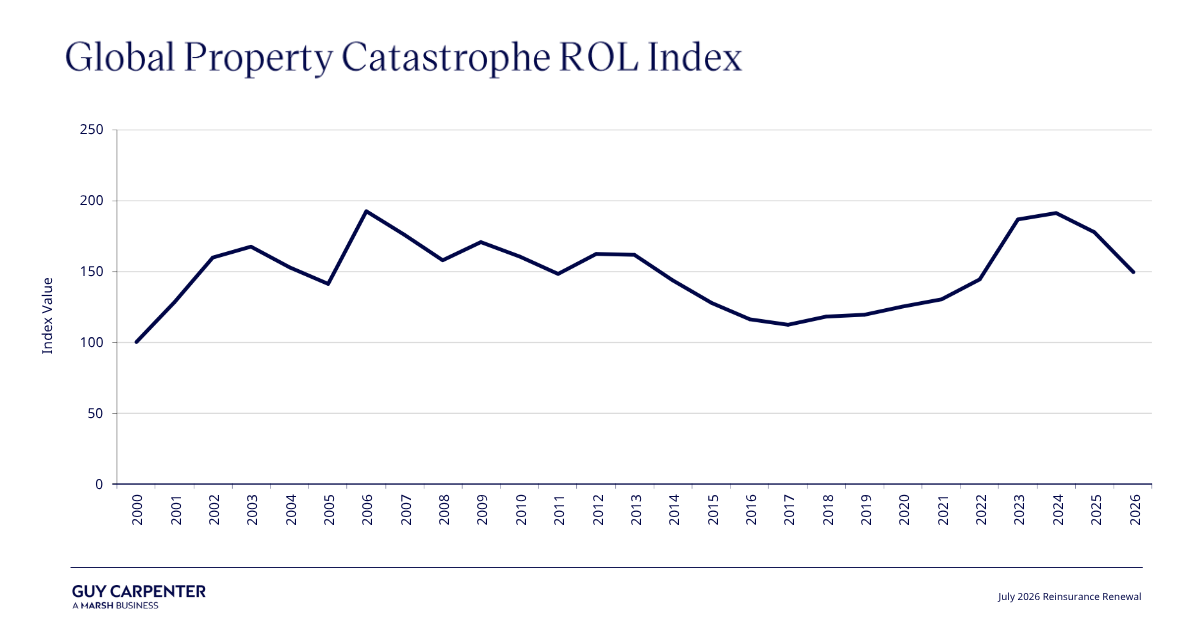
Guy Carpenter Global Property Catastrophe Rate on Line Index, July 2026.

Two contracts covering similar risks can therefore carry different economics depending on when they were written.

Between windows, price exists only where paper trades

Reinsurance risk develops throughout the life of a contract, while the terms agreed at renewal remain in place for its duration. Risk can change continuously without its market price changing continuously.

Catastrophe bonds are the main exception, trading in a secondary market between issuance and maturity. Even there, monthly volume runs around $350 million to $450 million against more than $65 billion outstanding. [7] [8] Traditional reinsurance generally has no liquid secondary market through which that exposure can be repriced before renewal.

The capital doesn’t keep the same hours

Global reinsurer capital reached a record $790 billion at March 31, 2026, according to Aon. Traditional equity was broadly unchanged at $649 billion, while third-party capital increased 4% during the first quarter to a record $141 billion across catastrophe bonds, sidecars, industry loss warranties, and collateralized reinsurance. [2]

Capital can accumulate throughout the year, while opportunities to deploy it into traditional reinsurance remain concentrated around renewal and issuance periods. When available capital grows faster than demand for protection, the effect becomes visible when business returns to market and is reflected in negotiated terms.

Guy Carpenter attributed continued softening in property catastrophe pricing through mid-year to benign loss activity, abundant capacity and growing reinsurer appetite. [5] Aon similarly reported global reinsurance demand increasing by more than 10%, with available supply still sufficient to meet that growth. [2]

The capital-markets clock therefore influences the underwriting clock, but the effect is registered when risk comes back to market.

Collateral runs on the second clock

For collateralized reinsurance, underwriting is one part of the economics. The capital supporting the contracts is held in reserve assets that can generate income while supporting the underwriting portfolio.

The pricing and contractual terms of a reinsurance position are established when the risk is bound. Premium is earned over the risk period, while claims and changes in expected losses can affect underwriting performance as events develop. At OnRe, the reserves supporting those obligations are held in a segregated account and allocated across yield-bearing stablecoins and tokenized Treasuries, generating reserve income throughout the underwriting period.

The two therefore develop on different clocks: underwriting performance reflects terms established at binding and subsequent loss experience, while reserve income reflects the yield earned on the assets supporting the portfolio.

Read: Why ONyc's Yield Doesn't Break When Markets Do

What onchain changes

Bringing reinsurance onchain preserves the underlying economics of the asset class. Renewal dates, defined risk periods, capital requirements, and loss exposure continue to govern the underwriting portfolio. The infrastructure around the asset changes the mechanisms through which investors access the exposure and the frequency with which capital deployment, reserve positions, and portfolio performance can be observed.

At OnRe, underwriting and reserve asset income are reported separately. More frequent reporting provides greater visibility into capital deployment, reserve assets, underwriting activity, while the underlying reinsurance retains its existing duration, loss and liquidity characteristics.

For institutional capital, this creates a more observable form of exposure to a market that has historically been closed off and periodically reported.

Reading the two clocks together

Reinsurance risk continues to evolve after a contract is bound, while the contractual terms on which that risk was written are largely fixed until renewal. The capital supporting that risk can continue to generate income throughout the risk period.

For an investor evaluating a collateralized reinsurance portfolio, the practical question is which clock is driving the number being reported. Earned premium, reserve asset income, insured events, changes in expected losses, and new renewal terms can affect the portfolio at different points in time. Separating these drivers allows more frequent portfolio reporting to be interpreted without assuming that the underlying insurance risk is itself continuously repriced.

The underwriting clock sets the terms on which risk enters the portfolio. The capital-markets clock continues to operate while that risk is held. Understanding a collateralized reinsurance portfolio requires reading both.

Sources

[1] S&P Global Market Intelligence, “Jan. 1 renewals set stage for lower reinsurance prices in 2026,” 29 January 2026.

[2] Aon, “Reinsurance Market Dynamics, Midyear 2026 Renewal Report,” July 2026.

[3] Gallagher Re, 1st View, “A Moment for Creativity,” 1 July 2026.

[4] Guy Carpenter, July 2026 Reinsurance Renewal Report, regional detail on European and Asia-Pacific renewals, reported 29 June 2026.

[5] Guy Carpenter, “July 1, 2026 Reinsurance Renewals: Property,” 1 July 2026.

[6] Guy Carpenter Global Property Catastrophe Rate on Line Index, January 1 and mid-year 2026 readings.

[7] Plenum Investments, “The Reinsurance Structure Supports CAT Bond Liquidity,” Nico Rischmann.

[8] Swiss Re Capital Markets, “ILS Market Insights,” H1 2026 secondary-market activity, reported 28 July 2026.

Share this article
Up next
No items found.

Bridging reinsurance and crypto to create real, scalable yield