Insights

Underwriting Discipline in a Well-Capitalized Reinsurance Market

September 23, 2026
 - 
5
 min read

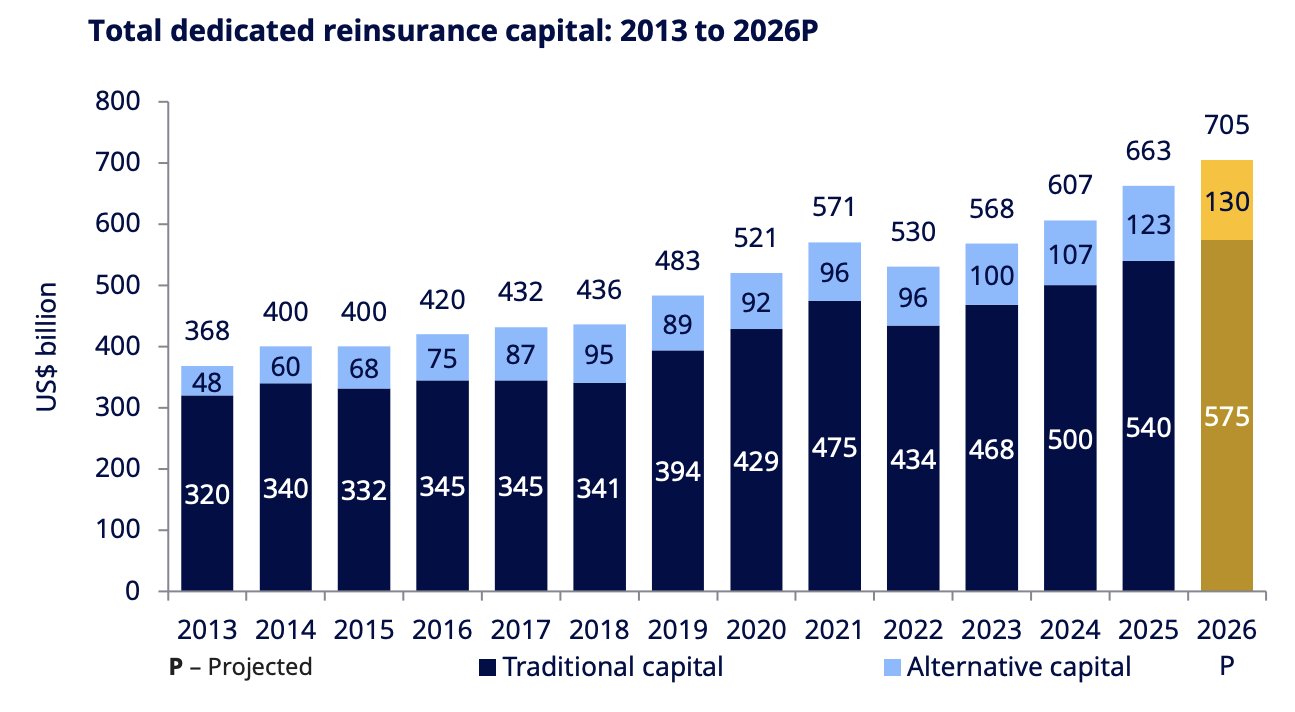
Reinsurance capital has never been larger. Dedicated capital increased from $607 billion in 2024 to $663 billion in 2025 and is projected at $705 billion in 2026,⁷ supported by retained underwriting profit, investment returns, and growth in third-party participation.
Image
Total dedicated reinsurance capital; Source: Marsh Re, AM Best - a refined approach to estimation of dedicated reinsurance capital.

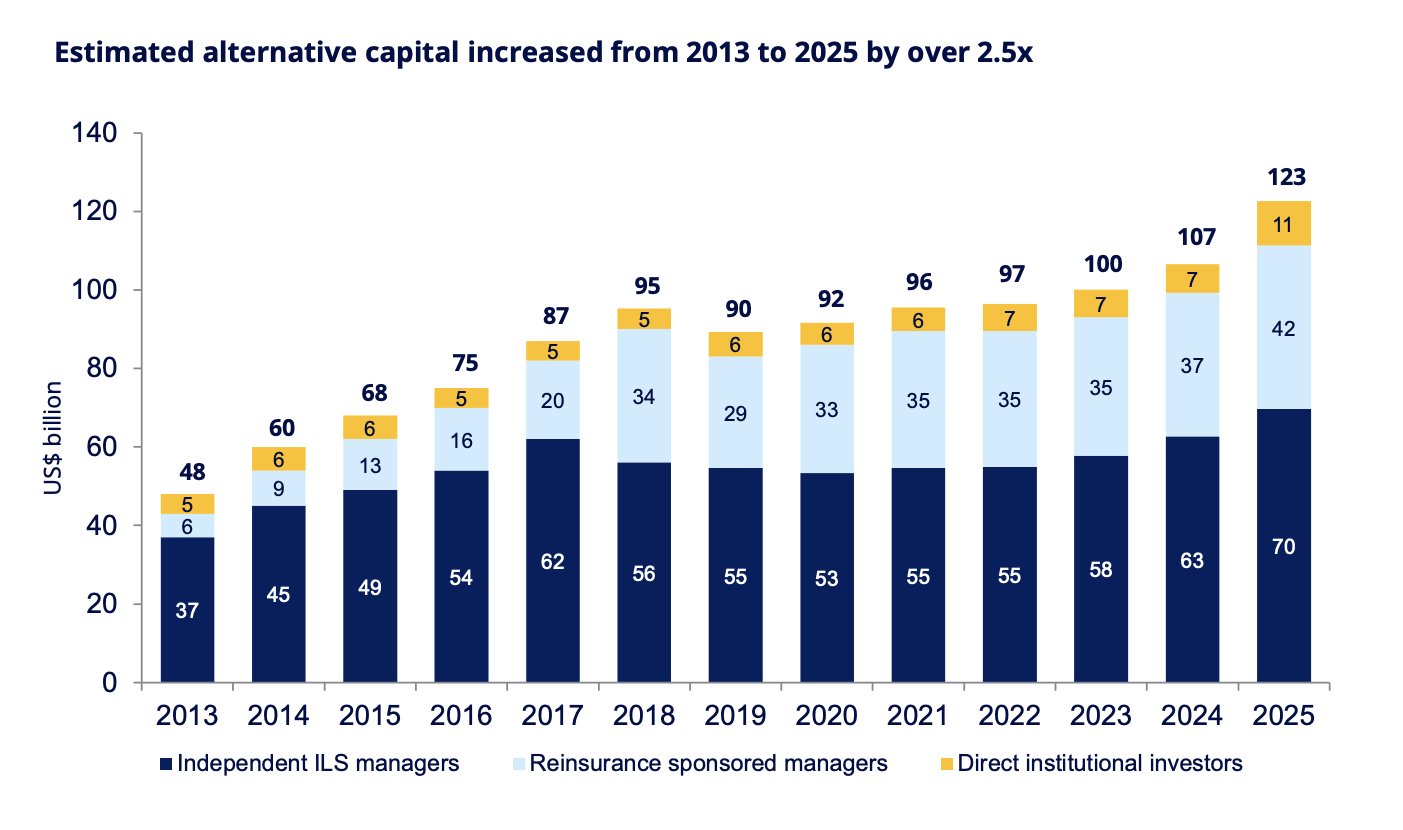
Third-party capital alone reached $123 billion by the end of 2025 and is projected to grow to around $130 billion in 2026, according to AM Best and Marsh Re. Direct institutional investors grew their allocations fastest, by roughly 57% over 2025.²
Image
Estimated alternative capital in reinsurance, by manager type; Source: Marsh Re.

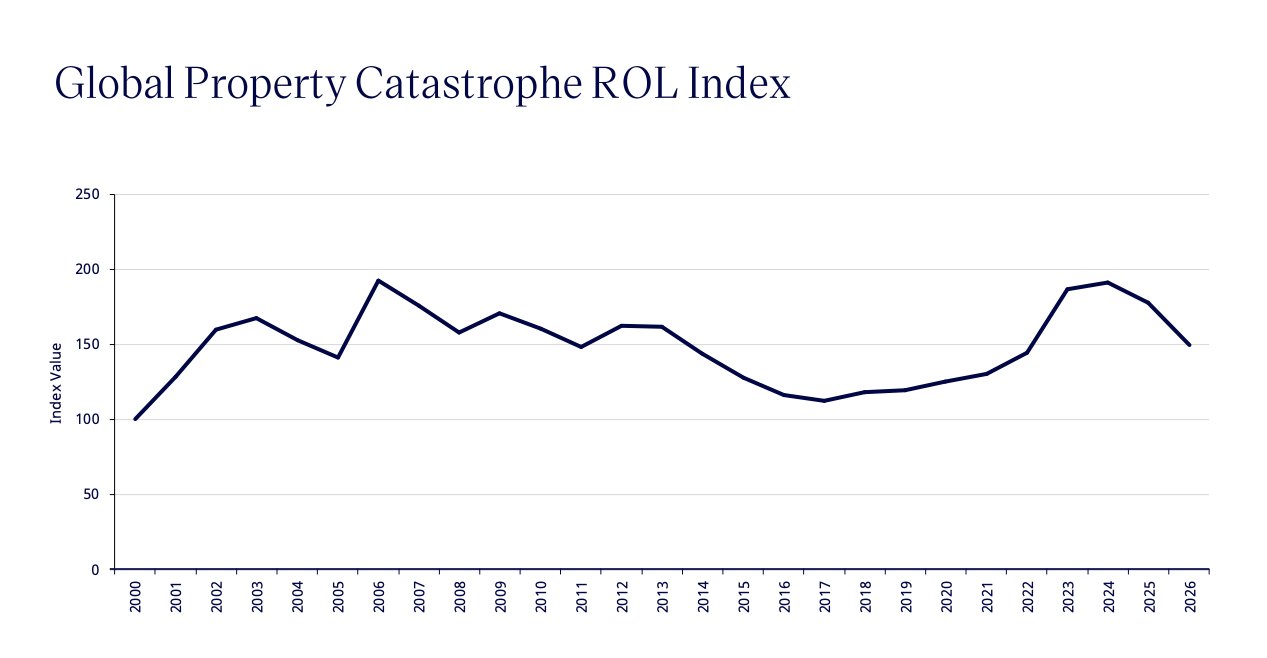
Pricing has moved in the opposite direction over the same period. The Marsh Re Global Property Catastrophe Rate-on-Line Index was down 16% at midyear,³ while property catastrophe capacity at the 1 January renewal exceeded demand by more than 25%.⁴
Image
Global Property Catastrophe Rate-on-Line Index, measuring reinsurance pricing over time, based on the premium paid relative to the amount of coverage provided; Source: Marsh Re.

AM Best has questioned whether underwriting discipline can hold amid record capital,⁵ while Howden Re has noted that further rate reductions would place greater weight on risk selection and portfolio construction.⁶

For OnRe, underwriting performance is shaped long before loss occurs. It is built through risk selection, structure, attachment points, portfolio construction, and the decision to leave capital undeployed when opportunities fall short of the required standard.

Underwriting starts with where risk attaches

One of the clearest examples is the attachment point, the level at which a reinsurance contract begins absorbing losses. A contract attaching at $500 million, for example, responds only once losses on the covered book exceed that amount, leaving smaller events with the cedent.

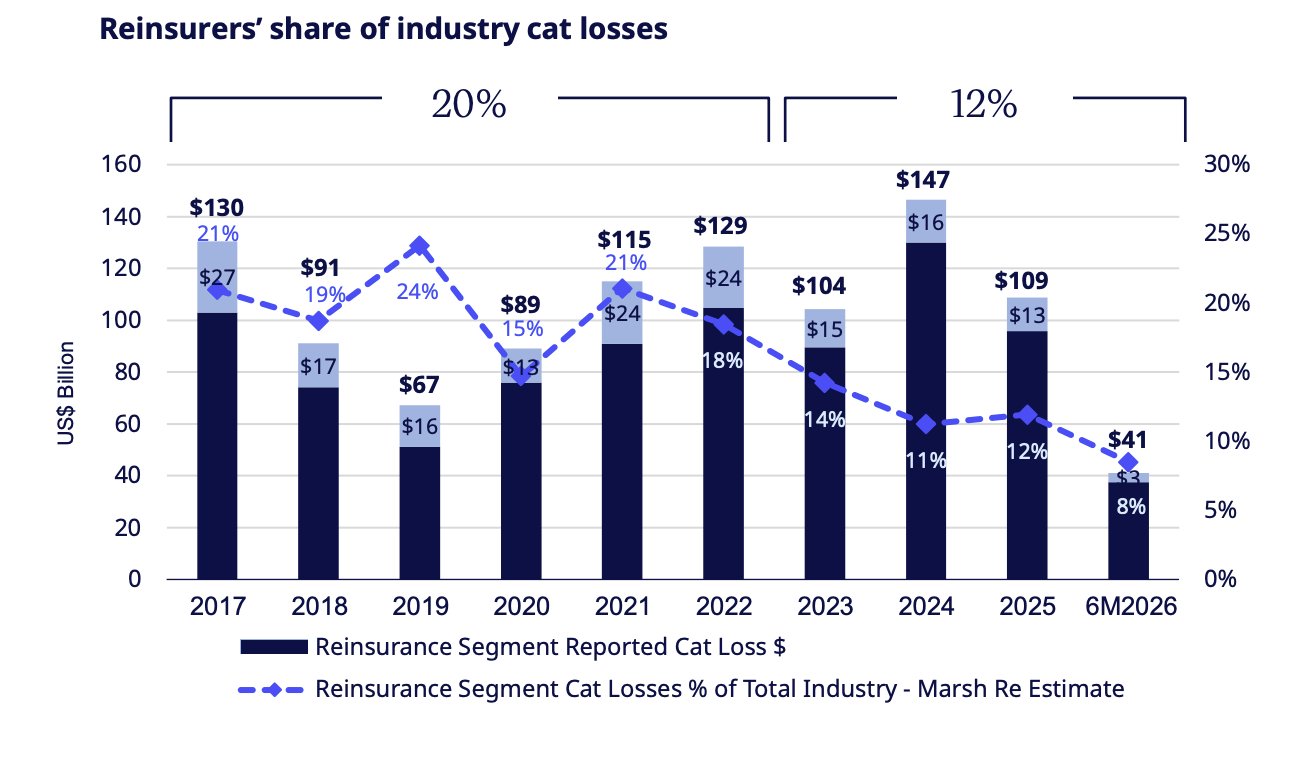
The reinsured share of global catastrophe losses has declined from roughly 20% before 2023 to an average of approximately 12% since then. Marsh Re attributes that shift to a combination of higher attachment points following the 1 January 2023 renewal and a lower incidence of high-severity events.⁷

Image
Reinsurers' share of global catastrophe losses declines; Source: Company reports, Marsh Re calculations. Note: Reinsurers’ share is based on reported cat losses for the reinsurance segment of select companies in the Marsh Re reinsurance composite and assumes the cohort represents 65% of the industry.

A quieter loss environment contributed to recent results, although the attachment points behind them were set in advance of those losses. Higher attachment points can reduce exposure to more frequent events while preserving capacity for less frequent, more severe losses. Across the Marsh Re reinsurance composite, return on equity reached 18.9% in 2025,⁷ a result shaped in part by positions set at renewal, months before the year's losses were known.

What crosses the desk before it becomes a line

Price is one of several inputs to an underwriting decision. Before OnRe accepts exposure, the underwriting process considers underwriting guidelines and pricing approach, claims history and expected claims behavior, the structure and limits of the exposure, the quality of policy and claims data, and the regulatory environment in which the cedent operates.

That review matters because a reinsurer inherits the underwriting decisions embedded in the underlying book for the duration of the agreement, and strong treaty terms cannot compensate for weaknesses in the portfolio beneath them.

Some opportunities fall outside OnRe’s scope regardless of the premium available, including unlicensed programs, exposures that cannot be adequately modeled, and structures without sufficient data transparency or regulatory oversight. These exclusions are underwriting parameters, set independently of price, that determine whether a risk belongs in the portfolio at all.

Portfolio construction

Individual risk selection is the first layer of the process, and the second is determining how those risks interact at the portfolio level.

Over the next 12 months, OnRe is targeting a portfolio split between specialty programs and property catastrophe industry loss warranties (ILWs). The two segments are deliberately different in structure and risk profile.

Specialty programs will be selected for factors including consistent policy and claims data and comparatively predictable claims behavior, across lines including directors and officers, cyber, technology errors and omissions, aviation, crop, marine offshore, and energy.

Property catastrophe ILWs settle against independently verified industry loss indices using binary triggers at high attachment points, paying out when total industry losses from an event exceed a defined threshold. They cover perils including North American and international wind, earthquake, flood, wildfire, monsoon, and hail.

The two segments are intended to bring different risk characteristics to the portfolio. Specialty underwriting will emphasize the quality and predictability of the underlying book, while ILWs reduce reliance on a cedent's own loss reporting and use higher triggers to limit exposure to more frequent events. Portfolio construction becomes another form of risk selection, extending the decision from individual contracts to how exposures interact across the broader portfolio.

Where OnRe's capital sits

Underwriting discipline becomes most visible when available capacity exceeds attractive risk, and OnRe’s positioning, as of 22 September 2026,⁸ provides a current example. The portfolio comprises 30 bound deals representing $152.72 million of capital on risk, or 50.73% of AUM. The remaining capital is held in collateral, where it continues to earn returns and remains available to deploy as qualifying risk comes to market.

Maximizing premium written and maximizing risk-adjusted return are separate objectives. OnRe deploys capital when the underlying risk, structure, pricing, and portfolio fit justify it, regardless of how much capacity the market is offering.

Selectivity can mean writing less business as competition increases and pricing softens. OnRe accepts that trade-off because premium volume adds value only when the economics of the underlying risk remain attractive, and it sizes its book to that standard.

Discipline does not eliminate risk

OnRe’s risk management framework targets a loss probability of approximately 0.5% through structured underwriting and active portfolio management, within applicable regulatory requirements including the Bermuda Solvency Capital Requirement (BSCR) set by the Bermuda Monetary Authority.⁹

That target does not constitute a guarantee. Catastrophe models carry uncertainty, particularly in the tail, and losses above reserved levels can reduce NAV. Concentration and correlation also remain relevant across the portfolio, even with position limits and geographic diversification in place to manage them.

The objective of underwriting discipline is to decide deliberately which risks the portfolio is being compensated to take.

Underwriting through a softening market

The eventual performance of a portfolio begins well before pricing, with the cedents selected, the data required, the structures accepted, the attachment points chosen, the concentration limits imposed, and the capital deliberately left undeployed when those conditions are not met.

That sequence matters most in a market with record capital and softening rates. More available capacity creates more opportunities to write business, but it also puts greater weight on risk selection, portfolio construction, and the discipline to deploy capital selectively.

Notes

1. Insurance Journal, “Can Reinsurers Maintain Underwriting Discipline or Will ‘Irrational’ Competition Return?” 10 August 2026.

2. Artemis, “Direct institutional investor allocations to reinsurance grew at fastest rate in 2025: Marsh Re,” 23 September 2026.

3. Artemis, “Global and US property cat rates down 16%, APAC 19% after July renewals in 2026: Guy Carpenter,” 30 June 2026.

4. Guy Carpenter, January 1, 2026 Reinsurance Renewal Report, January 2026.

5. AM Best, “Market Segment Report: Global Reinsurance at an Inflection Point: Can Discipline Survive the Temptation of Record Capital?” 10 August 2026.

6. Howden Re, “Filtered for quality: Howden Re on capital, discipline and the mid-year market outlook,” 29 June 2026.

7. Marsh Re, “2027 Renewal Outlook: Driving Impact Through Insight,” September 2026.

8. OnRe, "Transparency Dashboard portfolio data," 22 September 2026.

9. OnRe, "Technical Documentation Reinsurance Framework: Claims and Risk Management," September 2026.

Share this article
Up next
No items found.

Bridging reinsurance and crypto to create real, scalable yield