Allez Labs has published its July 2026 Asset Risk Assessment of ONyc, an independent 42-page review covering thirteen risk components across Market & Liquidity, Technical & Counterparty, and Operational & Governance risk.
The overall assessment: High Quality Collateral
The report examines what drives ONyc's returns, how reserves are verified, how catastrophe losses could affect NAV, and how those risks could flow through ONyc's DeFi integrations.
Here are some of the key findings.
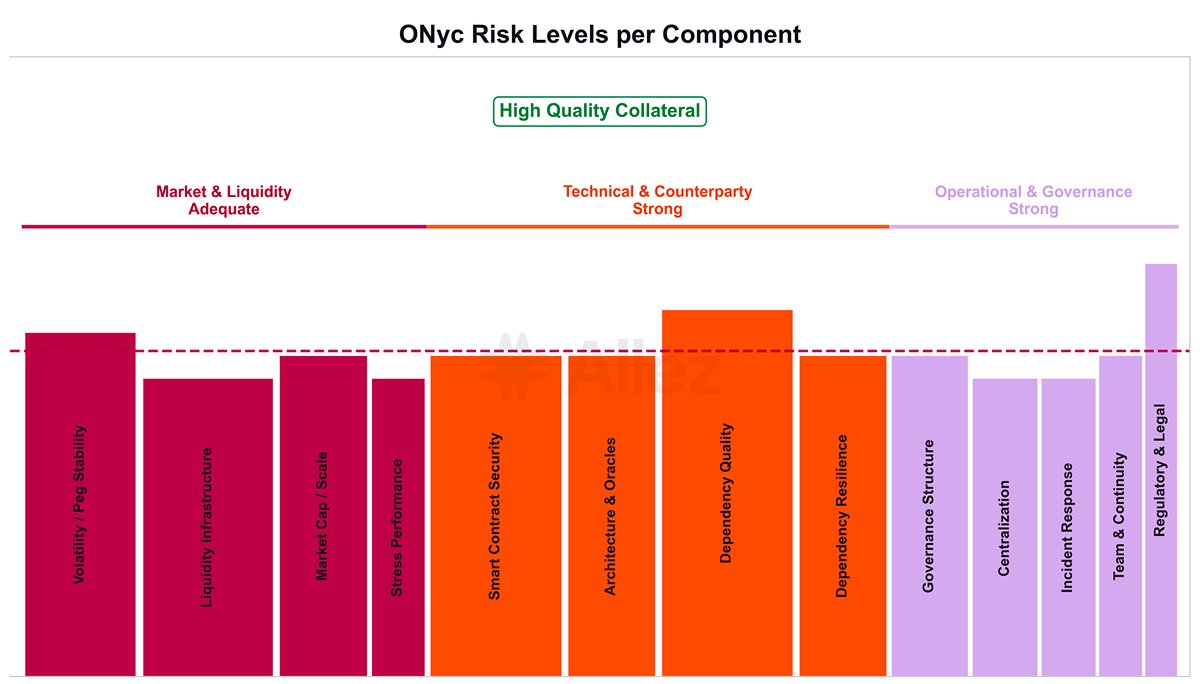
Why ONyc is assessed as High Quality Collateral
Nine of thirteen components received a Strong assessment, while Liquidity Infrastructure, Stress Performance, Centralization, and Incident Response were assessed as Adequate. Allez identifies several areas for further development, including governance timelocks, currently being implemented.
Allez describes ONyc's regulatory posture as "one of the strongest regulatory postures observed among Allez-reviewed RWAs," highlighting dual BMA licenses, BSCR compliance, statutory segregated-account ringfencing, and SOC 2 Type II certification.
The assessment also points to ONyc's institutional custody and attestation stack, onchain architecture, and smart-contract security history, including five completed audits, with a sixth completed since the report's snapshot.
Understanding the risk behind ONyc's yield
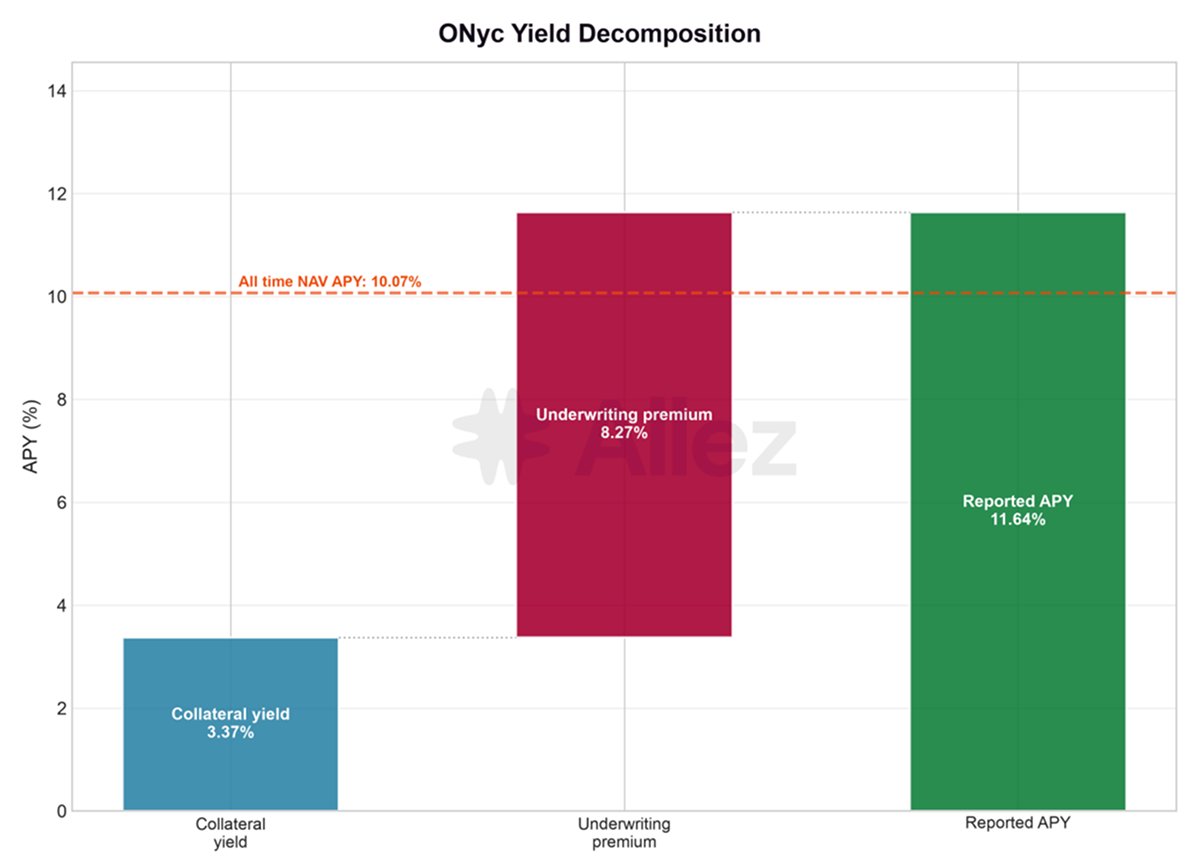
ONyc's return comes from two distinct sources: reinsurance underwriting and income generated by the collateral supporting the portfolio.
At the July 31 snapshot, Allez reported 11.64% APY, consisting of approximately 8.27% from underwriting premium and 3.37% from collateral yield.
A major catastrophe claim would reduce underwriting income and, if losses exceed earned premium, compress NAV by the resulting net claims paid.
The asset side of NAV can be independently verified. Extending that review to the underwriting methodology is identified as a further step that could strengthen the assessment.
What could cause ONyc's NAV to draw down?
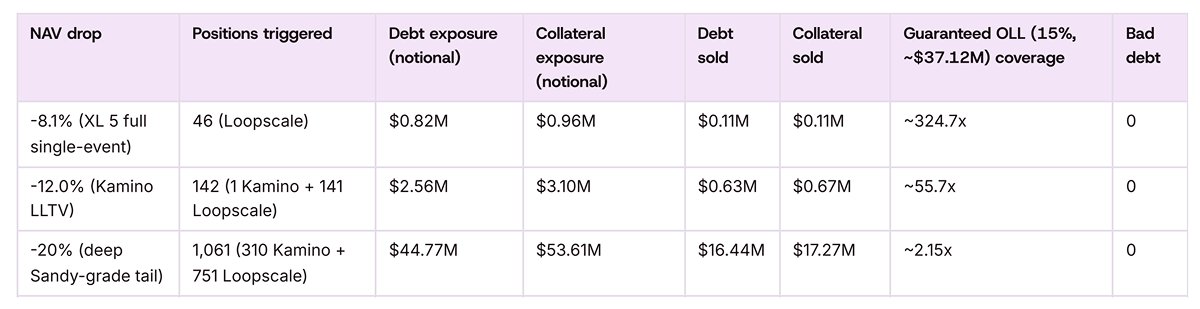
Allez models an approximately -8.1% NAV impact if the portfolio's largest single treaty were to incur its full $20M limit.
Allez also applied a Sandy-equivalent event across applicable treaties in OnRe's portfolio. The resulting modeled NAV impact ranged from -13.1% to -22.1%, showing the potential effect of a major catastrophe affecting multiple treaties.

What that could mean for DeFi
Because ONyc is used as collateral, Allez runs modeled NAV declines through actual leveraged positions on Kamino and Loopscale.
Across the three scenarios modeled in its joint stress test, the liquidation cascade clears with zero bad debt. Even at a -20% Sandy-grade NAV decline, approximately $17.27M of collateral is sold against the $37.12M Liquidity Layer, providing ~2.15x coverage.
The report also highlights the growing scale of ONyc's use across DeFi. ~52.6% of supply was deployed in the Kamino lending market, making liquidity and venue concentration areas of focus in the assessment.
What has already been tested
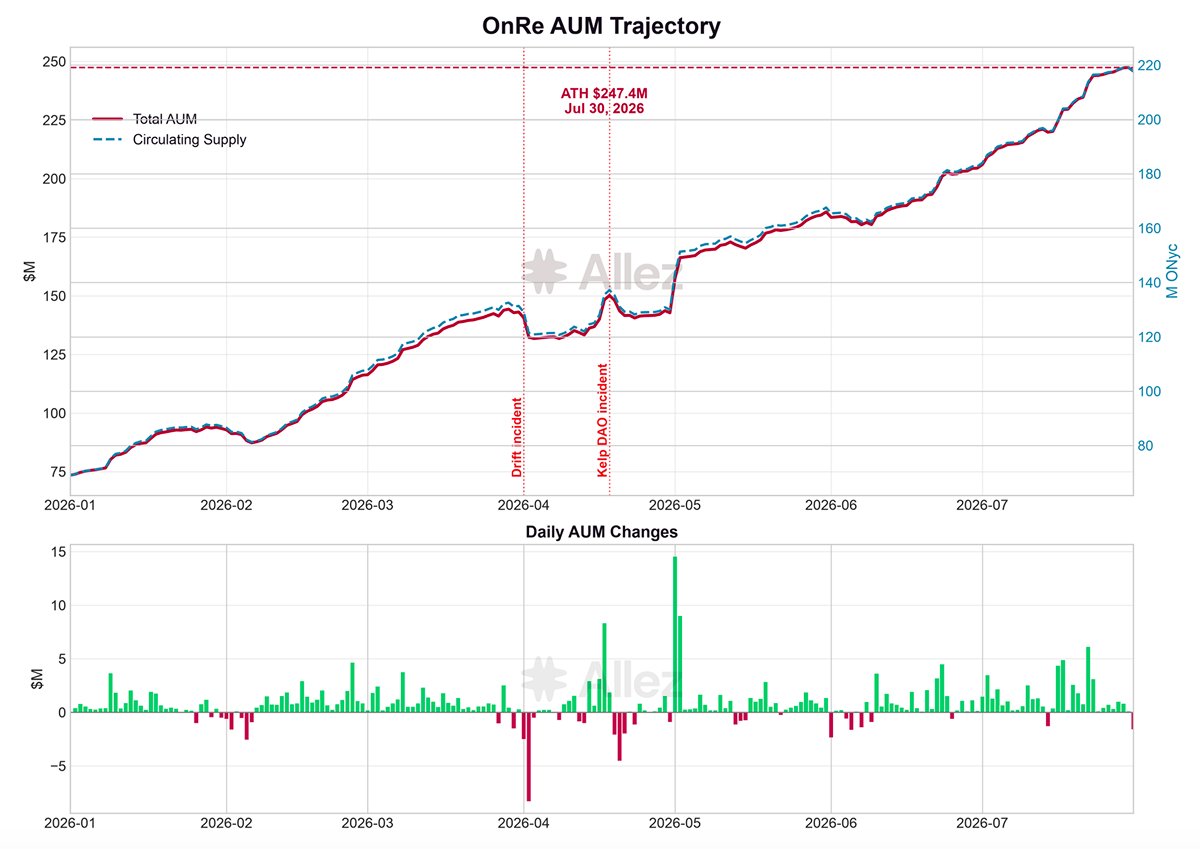
ONyc's response to a material catastrophe loss remains modeled, but its behavior through several periods of DeFi liquidity stress has already been observed.
Allez documents four events: broader market volatility in late 2025, the December 2025 DDoS incident, the April 2026 Drift-hack aftermath, and the Kelp DAO incident later that month. All four were absorbed without a peg break or bad debt, with NAV continuing to accrue. Across the 429-day track record assessed, ONyc's maximum drawdown was -0.24%, with zero negative months.
The largest single-day outflow occurred on April 2, when ONyc experienced an $8.3M net outflow, equal to 5.90% of then-AUM. During the Kelp DAO event, circulating supply contracted by approximately $8.5M over four days; oracles held at NAV, no ONyc-related liquidations were recorded, and AUM subsequently recovered.
How Allez verified the assets behind ONyc
The assessment includes a detailed Proof of Reserve, documenting the assets supporting ONyc across multiple verification channels.
Onchain reserves were directly queried by Allez using the underlying wallet and program addresses, while offchain assets were documented through custodian statements and third-party evidence.
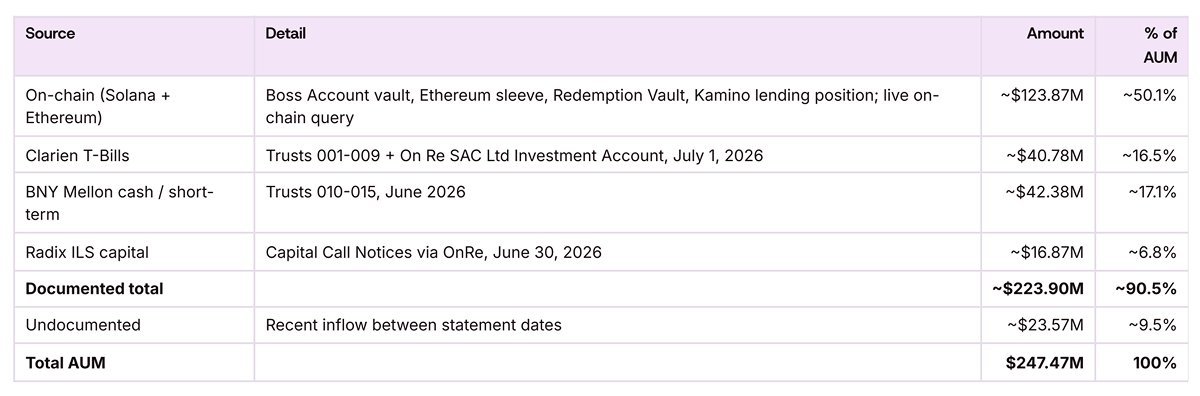
Approximately 90.5% of AUM was documented: ~50.1% through Allez-verified onchain assets, ~33.6% through custodian statements, and ~6.8% through third-party documentation. Allez assigns its Proof of Reserve data High confidence.
The remaining ~9.5% reflected recent inflows after the relevant statement cutoffs. Allez expects this residual to be reflected in the next custodian and attestation cycle.
Read the full ONyc Asset Risk Assessment, conducted under the Allez Asset Risk Framework.
Disclosure: Allez Labs’ Asset Risk Assessment is a proprietary, point-in-time risk assessment provided for informational and analytical purposes only. It is not a credit rating, investment recommendation, or financial, legal, tax, technical, security, or compliance advice or audit. Assessments are based on Allez’s methodology and information available at the time and may change as market conditions or information change. Readers should conduct their own due diligence and seek appropriate professional advice before making investment or business decisions. See the full Allez Labs report for complete disclosures and limitations.
.png)