There is a tendency in this market to chase what appears to be progress.
Faster systems, greater leverage, improved user experience, and deeper composability have all contributed to the growth of DeFi. These developments are meaningful and should not be dismissed. But with the recent hack of Drift, I feel DeFi always returns to the same question.
What actually supports the system when it is under stress?
Not what moves the fastest or integrates the most, but what absorbs risk, carries it, and ultimately settles it when conditions deteriorate.This is the question the market is returning too. It is the correct one.
Where is DeFi Going?
The evolution of DeFi has been clear.
Early systems such as Aave were built around simplicity and constraint. Users deposited collateral, borrowed against it, and managed liquidation risk within a relatively transparent framework. Over time, the system evolved toward greater capital efficiency. Protocols such as Kamino, Loopscale, and Morpho represent a more advanced phase. Capital can be reused, positions can be structured with greater flexibility, and markets operate with significantly more sophistication. As we mature we are seeing even more unique products like tranching from Exponent and Strata.
This progression is real and necessary. However, it introduces a new requirement.
As systems become more efficient, they become more sensitive to the quality of their inputs. Weak collateral leads to fragile systems. Reflexive yield introduces cyclicality. Shared assumptions increase correlation across protocols and thereby “contagion” risk. There are structural realities and shifts that the market is now beginning to price more carefully, I am happy to see more vaults/curators consider this. And do believe that the presence of such actors is a necessary step to grow and mature DeFi.
Allocation Vaults: Primer for Institutional Asset Managers: https://x.com/RWA_xyz/status/2026680537163674038?s=20
Where OnRe Fits...
Any durable system begins with the asset.
The key question is not simply how an asset behaves on-chain, but where its yield originates and how that yield is produced.
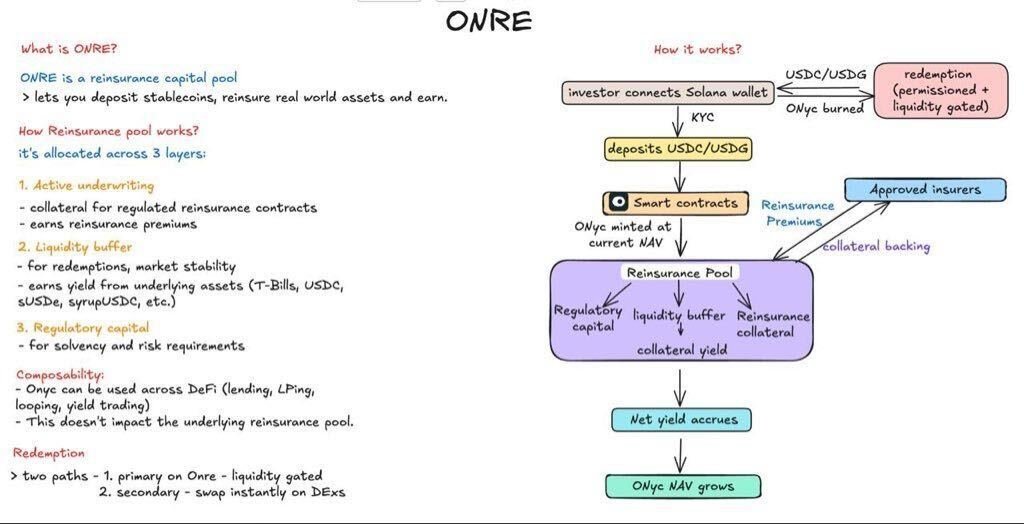
At OnRe, the focus is on underwriting. Capital is allocated across short-duration reinsurance through a combination of in-house underwriting, partnerships with MGAs, and allocations to ILS funds based in Bermuda. These are established markets with decades of operating history, defined structures, and participants who have navigated multiple cycles. The objective is not to create a new category of risk. It is to access an existing one with discipline and bring it on-chain in a form that is structured, scalable, and usable.
ONyc reflects this approach.
Its yield is generated from underwriting real risk. The duration of exposure is known. Risk is priced at inception. Performance is not dependent on crypto market conditions. Albeit OnRe as a business certainly relies on the industry for its demand/AUM, we are taking the steps to invite capital willing to justify OnRe risk with better system/data readily available. A clear cut understanding of DeFi and Reinsurance.
Real-World Returns, Onchain: https://x.com/onrefinance/status/2000641238354243926?s=20
This is Not About Becoming Risk Free
No financial system eliminates risk. That is neither realistic nor desirable. I can’t disclose the amount of times I have heard “we want risk-free returns”. However, as the ecosystem matures such a concept alongside outstanding returns is nonsensical. Our job is not to guarantee yield, but to make risk explicit, bounded, resilient, and predictable.
We are working toward a system in which ONyc can serve as a highly effective form of collateral within DeFi. This is not because it avoids risk, but because the nature of that risk is well-defined. When duration is known, exposure is modeled, and yield is sourced externally to crypto, the asset becomes usable in a different way. It can support leverage, lending, and structured strategies without introducing hidden dependencies. Across both reinsurance operations and onchain integrations, the focus has been on ensuring that ONyc behaves consistently across market conditions and can be integrated without distorting the systems around it.
My thesis is simple, while ONyc is an asset that earns yield, it is becoming more than that. It serves as core infrastructure to curators, vault managers, and onchain funds looking to maximize capital efficiency.
The Ultimate Guide to OnRe: https://x.com/Rockaway_X/status/2016604685613085161?s=20
Integration Determines Relevance
We have focused on the practical constraints that have historically limited RWAs. Pricing must be transparent and tied to a reliable reference. Redemption pathways must be defined. Liquidity must be designed with intent and highly efficient pricing. The asset must behave predictably when integrated into other protocols.
This has shaped our work with Kamino, Loopscale, Exponent, Elemental, Titan, and others. The objective is not simply to achieve integration, but to ensure that ONyc can be used effectively within these systems.
Looking ahead, the focus remains on depth. This includes improving liquidity across venues, strengthening collateral frameworks, enabling more sophisticated structured products, and reducing friction for users operating across protocols.
The OnRe Market on Kamino has crossed $100M in market size: https://x.com/kamino/status/2037933914011099288?s=20
This is why OnRe is taking the time to work with Apex Group, Accountable, Allez Labs, and top curators like RockawayX and Steakhouse. I would rather spend hours getting our due diligence firm, data, and risk parameters clear than operate in a closed silo.If there is more you want to see, i promise you we will work on it.
The Shift is Already Underway
The market is becoming more selective.
There is less emphasis on nominal yield and greater attention to durability. There is a growing focus on how systems behave under stress rather than how they perform in expansion.
It aligns with a broader maturation of the Solana ecosystem. The emphasis is no longer solely on performance and user experience. There is increasing attention on coordination between protocols, infrastructure quality, and long-term system design. Initiatives such as STRIDE, along with continued support from the foundation, reflect this shift toward building systems capable of supporting meaningful scale.
I do believe OnRe is a core piece of turning Solana's institutional vision into a reality.
The Quiet Shift in DeFi: From Yield Chasing to Collateral-Grade Assets: https://x.com/onrefinance/status/2011101449217065217?s=20
Time to Double Down
Periods of stress bring clarity. They reveal which assumptions hold and which do not. They force the market to re-evaluate what is foundational and what is incidental.
Our view is direct.
OnRe is positioned to contribute meaningfully to the next phase of DeFi. We combine a source of yield that is independent of crypto markets with a structure grounded in underwriting and a strategy focused on integration. We are continuing to expand integrations, deepen liquidity, define risk, and refine the underwriting system. No, this is not a reaction to current events, but as a continuation of a strategy that is aligned with where the market is heading.
So what’s the TLDR? If you want to work with OnRe and our growing ecosystem of partners, DM me. If you want to underwrite ONyc for your portfolio, yield strategy, or curation business, DM me. If you want to include OnRe into your data process, DM ME!
Time to take OnRe to a $250m RWA project built natively for DeFi.
.png)
.png)
.png)